
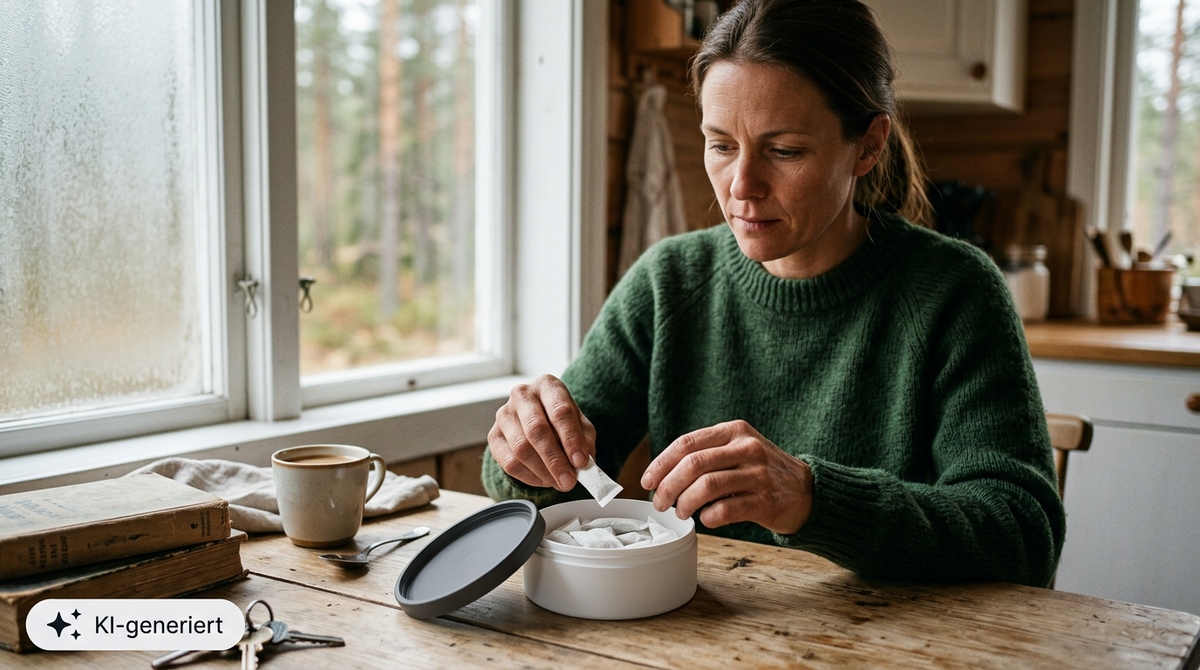
If you use all-white nicotine pouches, you’re probably familiar with the feeling of opening a tin and finding that the contents no longer have their usual consistency or expected flavor. This is often not due to the product quality at the time of purchase, but to storage after opening or while keeping a stock. Many users of tobacco-free nicotine products wonder how to store snus, since these products have different physical properties from traditional tobacco snus. While tobacco products can be more resistant to environmental influences thanks to their natural residual moisture and fermentation, plant fiber-based pouches are more sensitive to temperature fluctuations and humidity.
In this post, you’ll learn which factors affect the quality of nicotine pouches and how to store your supplies so they retain their properties until the date indicated. We’ll look at the role of room temperature, explain how the tin works as a protective barrier, and clear up common misconceptions about refrigeration. The aim is to give you a solid understanding of the material composition of tobacco-free products, so you can avoid unnecessary quality loss and always find your products in the condition you expect.
Important: Nicotine is an addictive substance. We do not provide medical advice. The information in this post is intended as general guidance for adults aged 18 and over.
Why Proper Storage of Nicotine Pouches Matters
All-white nicotine pouches consist of plant fibers, nicotine, fillers, humectants, flavors, and pH regulators. Since they contain no tobacco, they lack the preservative effect that tobacco leaves provide through their natural sugar content and other compounds. Instead, the stability of these products depends on precise formulation and an intact packaging chain. If you want to store snus, you need to understand that this is primarily about preserving a technical product whose components are designed to work together. Any variation in temperature or humidity can disrupt this balance.
The most common cause of quality issues is moisture loss. The humectants in the pouches are hygroscopic, meaning they actively interact with the surrounding air. If the air is too dry, the pouches release moisture; if it is too humid, they can absorb water. Both scenarios change the texture and release properties. Flavors are also volatile compounds that can evaporate or change chemically if handled incorrectly. Proper storage is therefore not an optional luxury, but a necessity to ensure product integrity throughout the intended period of use.
Room temperature and light protection as a foundation

Read more in SNUSBUCH: Snus and sports: discretion and everyday use on the go – explores the topic in greater depth in this guide.
For everyday use and short-term storage, room temperature is the standard. Ideal conditions are around 18 to 22 degrees Celsius in a dark place. Direct sunlight should be avoided, as UV light and the heat it generates can destroy aroma molecules and cause moisture to become unevenly distributed in the can. A cupboard or drawer in the living area is usually more suitable than open shelves or windowsills. Consistent room temperature is more important than an exact degree: sharp fluctuations between day and night put more strain on the material than a constant, slightly higher or lower temperature.
Many users wonder whether summer heat is a problem. Short-lived temperature spikes, such as those that occur indoors, are usually tolerable for sealed cans. However, prolonged temperatures above 30 degrees Celsius should be avoided, as they accelerate the aging process. The same applies in winter: extreme cold is less harmful than rapid changes between cold and warm. If you bring a can in from the cold outdoors into a heated room, condensation may form. So always let the can acclimatize while closed before opening it to prevent moisture from entering from outside.
The role of the can and closure
The packaging for all-white nicotine pouches is a functional component, not merely a marketing element. Modern cans are designed to form a barrier against gas exchange and moisture migration. The lid must be closed tightly after each use to stabilize the microclimate inside the can. A loose-fitting lid or damaged seal causes the humectants to lose their effectiveness and the pouches to dry out. This often happens gradually, so the loss of quality may not be noticed until it is irreversible. So handle the can with care and avoid mechanical stress that could affect how it fits.
In addition, many cans have a separate catch compartment under the lid. This serves a hygienic purpose, but also helps regulate the climate: it prevents used pouches from coming into direct contact with fresh ones and disrupting their moisture balance. Use this compartment consistently. If you notice that a can is damaged or the closure mechanism is sticking, it is advisable to use the contents soon or transfer them to a suitable airtight container. However, the original packaging always remains the reference for optimal storage conditions, as it is specifically designed to meet the needs of the nicotine pouches it contains.
Myths and facts about refrigerator storage
One of the most persistent myths about storing snus is that nicotine pouches must be kept in the refrigerator. This assumption comes from the tradition of tobacco snus, which was indeed kept chilled because of its biological material to prevent mold and further fermentation. However, this does not apply to tobacco-free all-white nicotine pouches to the same extent. Since they do not contain organic tobacco leaves that could spoil, refrigeration is possible for unopened cans, but it is often counterproductive for everyday use.
The main problem with refrigerator storage is condensation. Every time you take a cold can out of the refrigerator, moisture forms on the surface and potentially inside it, too. This unintended dampening can make the pouches clumpy and alter flavor release unpredictably. Nicotine pouches can also easily absorb foreign odors in the refrigerator unless they are perfectly sealed. Unopened cans can be stored in the refrigerator for long-term storage if they are also packed in airtight bags. However, for opened cans or everyday use, a stable room temperature is almost always the safer choice to avoid moisture cycles.
Shelf life, date labels, and quality characteristics
Every can of nicotine pouches has a best-before date. This date applies to unopened products stored correctly. It is not an expiration date indicating a health risk, but a guarantee from the manufacturer that the product will meet its specifications. After the best-before date, the flavor and nicotine release may diminish, but the product is not automatically unfit for consumption. In practice, correctly stored all-white products often retain acceptable qualities long after the best-before date. Nevertheless, it makes sense to rotate supplies using the first-in, first-out principle so you can always enjoy fresh products.
In addition to the date, sensory characteristics are important indicators of quality. Fresh nicotine pouches have a defined elasticity and a clear, variety-specific aroma. If the pouches seem bone-dry, crumbly, or have a neutral to musty smell, this is a sign of advanced moisture loss or aging. Such changes rarely occur prematurely when the product is stored correctly. Note that different brands and formats have different moisture levels; what feels “too dry” for one variety may be the expected condition for another. So always compare with the familiar condition of the same product when new, rather than making general comparisons between different manufacturers.
Would you like to read more about What happens if you swallow snus? Then we recommend our SNUSBUCH article «What happens if you swallow snus?».
Storing snus – Frequently asked questions (FAQ)
Do I need to store all-white nicotine pouches in the refrigerator?
No, room temperature is generally better for everyday use. Temperature fluctuations in the refrigerator can cause condensation, which negatively affects the moisture and texture of the pouches. Only unopened supplies intended for long-term storage can be refrigerated, provided they are also sealed airtight.
How long can nicotine pouches be used after the best-before date?
The best-before date is not an expiration date, but a quality guarantee from the manufacturer. If stored correctly, nicotine pouches can still be used after this date, although their flavor and moisture may gradually diminish. Checking for dryness or changes in smell is more informative than relying on the date alone.
What should I do if my nicotine pouches seem dried out?
Dried-out pouches usually cannot be fully restored, as moisture loss causes structural changes. The only way to prevent this is to close the can securely and avoid dry air from heating systems. Rehydration is not recommended, as it alters the product composition uncontrollably.
Does storage affect nicotine strength?
The nicotine concentration itself remains stable over time, as nicotine hardly degrades under normal storage conditions. However, the perceived strength may change if moisture is lost, since the release rate depends on how hydrated the plant fibers are. Dry pouches may therefore feel weaker even though their nicotine content is unchanged.
Conclusion
Properly storing all-white nicotine pouches does not require special equipment, but above all, attention to stable temperatures and an airtight seal. Room temperature and darkness are generally better for everyday storage than the refrigerator, which poses risks due to condensation. The best-before date is a guide, and correct handling can help you make the most of it. Regularly checking your supplies and always closing the can carefully effectively minimizes quality loss.
